
February 16, 2026
CU Boulder Students are Keeping the Game Development Industry Alive
1/24/26
“Jams are like when you have an energy drink, one burst of motivation and you get so much done in only one weekend,” says Creative Technology and Design Engineering (CTD) student Lucky Bonniwell. CU Boulder Game Development Club held the third game jam of the academic year this weekend: The Chocolate Teapot Game Jam. Chocolate Teapot is a British slang term for “useless”.
The event was held for 8 hours on Saturday at the ATLAS institute and submissions were due at 11:59 pm on Sunday. Fourteen CTD and CS students attended and worked on 3 distinct games: John Portalhands’ Chorelist, Pushing Pencils, and Carry the Chocolate Teapot Through Platform Hell. You can find the games here on Itch.io, a go-to website for jammers.
I interviewed participants about career aspirations in game development, the value of game jams, passions, and current projects.

ATLAS student Cross Hessler DJing for the game jam.


Q&A
Violet Scott: Creative Technology and Design Engineering BS & Computer Science BA
President of CU Game Development Club Violet Scott
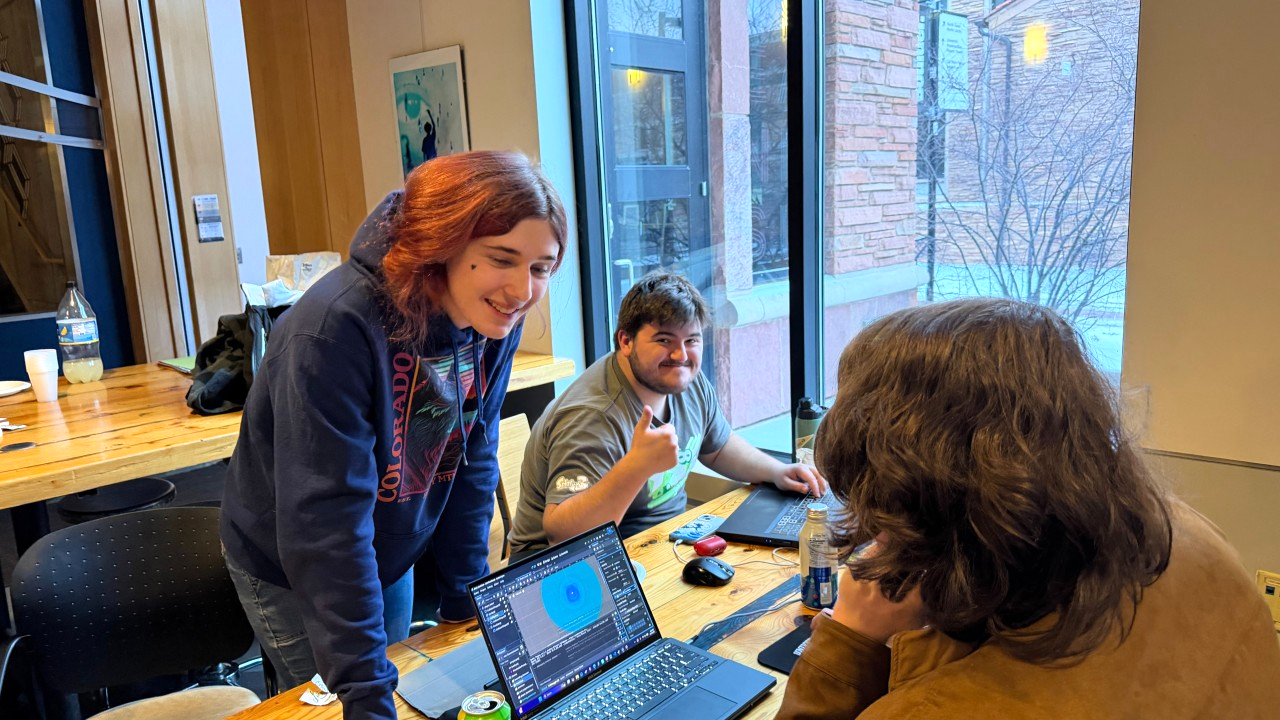
During the game jams, Violet acts as a mentor and resource for jammers. She spends her time assisting with technical skills and teaching.

What is your connection to game dev (development)?
Oh gosh, I guess it’s been something that I have done without even knowing for forever. When I was a kid, I would play Minecraft with my brother and build small games with each other. That turned into large scale minigames that used command blocks as code. We would have such a good time doing that, that it made me interested in learning how to code games for real. That moved to me starting to learn coding Spigot plugins with Java for Minecraft**.** How I got into development with game engines was through game jams. I participated in my first jam during early high school and I have done 6 jams since then and kept the same group of friends–my team–the whole way.
What is the CTD major?
CTD or Creative Technology and Design is an engineering major that tries to bring a more hands-on experience to engineering. So instead of learning about the theory of engineering, you directly build projects and make things.
It takes a very creative approach to a field that doesn’t generally have much creativity. You learn a level of project management skills, leadership skills in group projects, and build and make [things] using a large variety of technical skills. You also learn to use 3D printers and laser cutters and even work with a CNC router. We are learning how to prototype and really see a project through from beginning to end with polish and documentation.
What is your role in game projects?
Normally, I am programming games, coding systems, and writing mechanics.
I’m currently working on a dungeon-like room generator, but I have also worked on pixel art and 3D modeling. I have coded a small game engine as well.
What is your role in game dev club?
As the club president, I spend most of my time planning … and leading meetings. This last week, the activity we did used rented games [from] the Whaaat!? Lab (the game design lab in the ATLAS program). We had everyone play games then think about what they could change and then make those changes. The week before, we played human battleship and ultimate tic tac toe, which people loved.

What is it like, being a woman in game dev?
It’s interesting because the field of game development is not very diverse and it has been a focus of ours to bring in a more diverse crowd.
I wish there were more women in game development, I think that we bring so much to the table. Game development is all about stories, and there are so many more stories that need to be made by, for and about women.
For myself, the community has been very welcoming. I have never felt unwelcome in my space, but inequality is kind of always on my mind.
I have had experiences of people being weird with me and some uncomfortable experiences.
I would say diversity has gotten better, through our outreach, we have definitely found a good number of people that did not know they could do game dev. People believe that they have to be a programmer to do game dev. That belief is not reality. We are artists, graphics designers, writers, musicians, women and queer people. We have all grown up playing videogames, but many people have never had the opportunity to make games themselves. I [am] loving opening that world up to people.
What are some challenges you have faced in game dev?
Game development is really hard to do by yourself.
What I experienced for a very long time was having nobody to work with. Making sprites, writing countless lines of code, and working on multidisciplinary components takes a ton of time.
Doing it by yourself is nearly impossible. I have struggled with finding people to work with, but this club has really given me, and a lot of other people, the ability to work with other game developers. We made a space where we can actually connect with each other and start new projects together. It’s also a place for people who are looking into the industry. One way we could [support] each other is through getting together and maybe creating studios and working on projects. That’s something others here have expressed interest in doing, and it’s cool to see that happening in this space.
Who are your mentors here at CU Boulder?
Professor Jonas Wills: I took a class in game development, and the professor in that class was in the industry for 20 years and was known as a lead developer in DragonVale and part of Team Phobic. He taught me so much about game development–not just during class, but also during our talks after class. Last semester, he even came to our club and gave an amazing talk on the state of the industry and his experiences.
My other mentor is Danny Rankin: He is a professor I previously had for a class called Text, the director of the Whaaat!? Lab, and sponsors our club. He has always been incredibly supportive and helped with materials for the club.
What are some future goals for the game development club?
Our future goals are to grow game jams and to find more industry leaders who can come and talk to us. We want to connect club members with job opportunities in the industry and provide our community with a foothold in the insanity that is the industry.
Speaking of growing your community, did you say your club is attending a conference?
Yeah, so our club is actually attending the international Game Developers Conference (GDC) in March. We are taking about 10 of our members and it’s fully funded by CU Boulder. This conference is an amazing opportunity. Over 30,000 game developers attend, so there are great talks and opportunities to network. Game development can often feel isolating, but the conference reminds you that there are people and opportunities out there.
Jaden Cohavi: Computer Science BA, Creative Technology and Design Engineering Minor
John Portalhands’ Chorelist, Asset designer and Artist, Godot Programmer

What is your major and how are you related to game dev?
My major is in computer science CS (BA) and my minor is [in] creative technology and design and leadership. I didn’t have a lot of personal experience with making games before college. I took a coding class in high school, but nothing serious–just Scratch [games]. This club introduced me to a lot, including Aseprite [from a previous workshop on pixel art].
When did your passion for game development begin?
As a kid, making video games was my biggest dream. I was convinced it wasn’t a viable career option, but being in this club made me realize making video games is a real thing that people do as a job or hobby. Working with other people [like in game jams] is a useful skill.
What skills have you acquired from game jams?
I learned the most about art, but I also learned to work in Godot game engine [ a new kind of programming]. [I am] the type of guy who makes art and assets quickly. [I’ve also been] relearning how to make art because I hadn’t done it [since] high school.
Can you tell me a little bit about your game in the jam, John Portalhands’ Chorelist?


In the game you play as John Portalhands, whose wife has left him a list of chores to do around the house. However, with your hands being portals, you can’t grab things and you can only move things using the gravitational pull of your [portal] hands, which absolutely destroys your house in the process.
Our plan for the game was always to lean heavily into the absurdity of trying to complete basic household chores with portals for hands. Very early on into development, we decided to use pixelated and compressed PNGs of real images, which was hilarious to look at, fit the aesthetic we were going for, and also heavily cut down on time spent making assets. The majority of development time was spent making the physics work well, and I personally think it really paid off. While the game is decidedly very unfinished, we had a blast making it, and we’ll probably go back and continue working on this outside of the game jam just to see what else we can do with the concept. We’ve already come up with multiple level ideas and even a working teleportation mechanic that just never made it into the game. Either way, the jam was a great excuse to challenge and expand our skills, and we are looking forward to the next one!
Stuart Bogard: Computer Science BA
John Portalhands’ Chorelist, Designer, Godot Programmer, Physics Implementation

How do you connect to game dev?
I’ve always been interested in games, and [I’ve] also got interests in making something creative for people. [I] started with Minecraft and game mods, then I transitioned to Roblox around 6 years ago.
[My] friend and I were having fun trying to make projects in Roblox. Making things in 3D and trying 3D animation to create these projects pushed me towards game design. Roblox is a very accessible platform [for people trying to make games]. Recently, [we have been] trying to push boundaries [in Roblox].
What boundaries are you trying to push in Roblox?
There’s a project we have been working on for a couple years but [it’s] not shared yet–keep your eyes open for the release.
Cohavi added,
I can say I got a chance to play test one of the Roblox games and it was really good.

Developing the portal aspect of John Portalhands’ Chorelist
What are your aspirations for game development?
I want to create something for other people to enjoy and to be able to get my ideas out there. Games can engage people more than movies because they are so interactable. Similar to what Jaden was saying, I am majoring in CS, but if one of the Roblox games takes off I can focus on that and share my experiences with people. I would love to eventually open a game studio.

What do you think about your game in the jam, John Portalhands’ Chorelist?
Even though we may have tried to be a bit too ambitious when it came to gameplay elements, we tried to lean into our short timeframe by focusing on the silliness. Honestly, while the game might not be anything groundbreaking, it was really fun to develop. There were definitely some stressful moments, but we spent most of our time laughing and having fun with the various ideas we wanted to work into it.
After spending a long time working on serious projects, it was fun to make something purely silly. I am of the belief that you can’t make something that’s fun to play if you didn’t have fun making it.
Lucky Bonniwell: Creative Technology and Design Engineering BS, Cinema Studies Minor
Pushing Pencils, Pixel Artist, Designer, Concepts, Godot

How do you connect with game dev?
[I am a] CTD major and Cinema Studies minor. [I was an] artist in high school and my brother was a CS major. Together, we began making games 3 or 4 years ago, when I was a freshman or sophomore in high school. We made platformers, but also tried to make 3D games. [My] brother was mainly the programmer, but we both do [art and programming]. I am currently learning the coding language C#.
What are your career aspirations?
[I am currently] a freshman, but I hope to go into a game dev studio or maybe work on a film.
What role would you want in a game studio?
I would like to be a level designer or character designer. I want to make [and design] NPCs in a game with a larger world if I worked for a large studio.
What have you learned from jams?
Going over the software and Github, a file hosting service, is always confusing, and working with other people means difficult merge conflicts.
It is also hard to do things in a short time. Jams are like when you have an energy drink, one burst of motivation and you get so much done in only one weekend. It would take weeks to work on different projects with my brother, but you get more done (in jams) than you could in months.
What are some unique things about you?
I was good friends with people working on Star Citizen and I helped with concept art. It feels like people around me are moving up [in the industry], and I feel like [I am] part of the bigger community.
How do you feel about the connections and opportunities for people here in game dev club?
The community is really great. I especially [love] the game jams. We are stuck in a room together for 8 hours and we are all automatically connected even if we do not know each other beforehand.
What did you think about your game Pushing Pencils? What did you work on?

“Papers, Please” style game with fun puzzles and twists. Be careful not to clutter your desk to oblivion.
I mostly worked on the art that is seen throughout the game, [such as the] pixel art documents, memos, warnings and so on. I also helped design the mechanics of the game (using the pen and moving the papers) as well as added sounds for the interactions. I loved how polished our game looked and the feedback I have gotten from the people I have shown the game to.
Michael Santillan: Creative Technology and Design Engineering BS
Pushing Pencils, Pixel Artist, Designer, Godot programmer

Why do you participate in game dev?
It’s fun. Right now it is my creative expression. Game dev keeps me going.
Video games have always been a central piece in my life. I feel that games have the ability to tell stories and connect to players in a deeply meaningful way. For that reason, I want to create games as a career.
What skills have you acquired through game jams?
I have gained communication skills through my teams. But, I still do have a very hard time having patience [during jams].
Compared to working on a personal project for months, a game jam keeps me motivated.
In the CU Game Development Club’s previous game jam, your team won an award for level design?
[In the game Spooky Haunts], I [put myself in]the mind of the player and [predicted] the general path they would take based on the level. For one level, I developed a mini challenge room [leading to] a bigger challenge room. Most people actually played the level from mini room to larger room, and I was like “I am a mind reader!”. I like that part of level design.
How do you feel about Pushing Pencils?

I’m happy it came out as well as it did. So far, mostly everyone has had the reaction of “This is complete and utter bulls***. I love it.” I’m especially proud of the ending since I worked on it myself. It really gives off the ethereal and almost Kafkaesque style the fame was going for. A real “What the f*** did I just experience?” moment.
Declan Barnard: Speech, Language, and Hearing Sciences BA
Carry the Chocolate Teapot Through Platform Hell, Blender modeling, Programmer

What is your major, and how do you connect with game dev?
Okay, so, my major is a little weird. When I applied to CU Boulder I said CS because I love programming. I took a CS class and did not like how it was taught. CTD sounded cool, [and] I took classes, but I also didn’t like them.
I made a complete pivot to Speech, Language, and Hearing Sciences, but I still really like coding. I think making interactive stuff on computers and figuring out questions such as “how does that work?” and “how do you make it fun?” is really cool.
What did you work on in your game Carry the Chocolate Teapot Through Platform Hell?
I made 3D models and textures for the game, such as the teapot and the lava.
What are your favorite games?
I like Outer Wilds. It features such an excellent combination of gameplay and story, and every little piece of it comes together to make it work.
I am into rhythm games, but also kind of hate them. [I] love pressing buttons in time, but there is so much focus on points and scores and leaderboards. [I just] like playing for fun.
Would you ever want to work on a rhythm game?
Sounds hard. I love [the game] Rhythm Doctor because it’s simple and has no online leaderboard. As a one button rhythm game, it does so much with a simple mechanic. What’s also cool is that it is all audio cues, so you could play it with your eyes closed.
“Play it with your eyes closed?” That kind of sounds like a cool accessibility feature. What do you think about the recent increase in accessibility efforts in the game industry?
I enjoy thinking about accessibility because it is important to me. The game industry becoming more accessible is super cool. Captions being standard in games is a great thing.
I really like Celeste, but I was not good at that game and the assist mode feature gave me the opportunity to get into [it] at my own pace. I found it too challenging.
What is assist mode?
Assist mode tweaks different parts of gameplay, such as reaction time, through slowing the global game speed. Or, it might make it so that you can enable a time freeze after the first action to help with performing a double action [in Celeste]. You can also turn off death.
Do a lot of games have those sort of features?
Not sure, but I am sure Celeste wasn’t the first one [to]. What a lot of games will do, I’ve noticed, is to detect if you are struggling a lot on one specific part, and it will pop up an option to enable assist.
It is not a “difficulty setting”, [it’s so] you can tweak gameplay if the game isn’t working for you while still maintaining the original concepts of the developer.
For one game without assist features, I played the first Ori game (Ori and the Blind Forest) and I tried to get past this one difficult part. I played it over and over for weeks, but I had to drop the game because I couldn’t get past it. There was no assist, so [it was sad], I had to give up on the game.
There is a sort of idea of games either being a personal or a social thing. Like, if you play them alone for a hobby or competitively with ESPORTs. Some people play games to “show up” other people [and I do not judge that]. But differing opinions [about assist features] come from different social ideas about games.
Competitive shooter gamers are mad about aim assist on controllers, but it is a feature because it is harder to aim on a controller. Then, people argue “Is it a balancing feature or does it make it unfair?”
Are you interested in working in game dev?
I’m not interested in doing it as a job, but it is a really cool creative medium. I will always be doing some kind of tinkering with games. I really like the game jam format of meeting some new people and making some silly stuff.
I have also stopped being interested in programming as a job, partially because of AI, and partially because I prefer it as a hobby because of my interests. I like to code slowly and idealistically. I have a couple times filled up a white board about coding architecture.
In general, I’m very interested in human sensory experiences like light, vision, color, and sound. Video games are a fun way to explore those experiences and mess with them. [In a past project,] I wrote some code to try making a colorspace: a way to describe colors with numbers.
Currently, I’m trying to make a virtual speech synthesizer in correspondence with speech classes. [You] take into account tongue positions and model airflow as “turbulence” that changes the air from a structured wavy flow to an unpredictable flow. You basically use code to simulate it as an acoustic resonance tube with mathematical models for opening and closing the tube, then pass vocal chord frequencies through that.
Noah Harrington: Graduate Student, Creative Technology and Design Engineering
Carry the Chocolate Teapot Through Platform Hell, Unity programmer

How are you connected to game development?
I’m in the ATLAS Masters program here at CU. I mostly work with Danny in the Whaaat!? Lab.
Any current graduate school projects?
Just started a design journal this year to try to complete projects. [I have] completed tons of tutorials though. I am sort of trying to get out of tutorial hell.
What makes you passionate about game dev?
I have cared about videogames my whole life, but didn’t know you could make games. [In] high school, I saw Indie Game: The Movie, which follows developers in one person [and] two person teams.
I did my undergrad in Michigan, but it was not as good as it could [have been] because I went to a small college in my hometown studying New Media. There were only 3,000 students.
What are your aspirations after grad school?
Getting a job.
[My] dream is [to be] a solo developer, but I need money and things like insurance. [At CU, I am] making a portfolio to look good for “regular jobs” as well.
What makes your perspective unique in game development?
I think coming from a small town, I have a different perspective on interpersonal relationships.
STEM, Entertainment, and CU Boulder Campus Life
The CU Boulder Game Development Club invited student DJ for live music during the game jam.
Cross Hessler: Creative Technology and Design Engineering BS
DJ

DJ and CTD major Cross Hessler. Hessler mixed everything from classic 80s music to the Angry Birds Soundtrack.
What did you think about the submissions for the game jam?
I thought it was interesting how niche the games were. I liked how the plots and settings were unique and specific, especially the [game about] having portals for hands.
What are you passionate about?
This. I am also DJing for a class which is cool.
I like that DJing controls the room and makes people feel a specific way. It’s fun when you get to a point when you know what to play next and have read the room.
What are your aspirations after finishing CTD?
I would love to DJ.
But, I really like being here. I love this college and its culture.
What’s been new with Djing?
This was the first time I rented speakers instead of using random Goodwill speakers. I am part of the DJ community and go to Turn Table Tuesday every week [at a local bar]. Through this, I just got turn tables for free because another DJ appreciated my passion and gave me her old set.
I have been interested in DJing for 3 or 4 years but am just now actually doing it.
Where do you DJ?
Small parties, impromptu gatherings, BTU (Blow Things Up Lab).
Wrapping Up the Weekend
These CU Boulder students represent the future of the game development industry. In the face of AI concerns and industry tech giants, the community in Boulder, Colorado continues to pursue a future of personal, passionate, and unique games, which is a venture that indie studios value more than anything.
You can join virtual game jams globally through Itch.io. Also, remember to support indie studios and the cool people that make quirky games.
Learn more about CU Boulder and the ATLAS and CS departments.
About the Author:

Charlie Ghrist is the Social Media and Game Jam Coordinator for CU Boulder Game Development Club. They are a Biochemistry and Molecular, Cellular and Developmental Biology double major with passions in community outreach and events, biological research, and learning languages. Charlie fell in love with CU Game Dev Club through their passion of storytelling and the writing side of games. They are a Kentucky youth YMCA programs alum and continue to bring “Y-kid” energy to events they plan at CU Boulder.
About the Editor:
Albert Terry is a Chemical Engineering Major at the University of Kentucky - Paducah. His current passions include gaming, studying, and helping peers! He is a tutor and TA for a first-year engineering class. Albert attended the Gatton Academy of Mathematics and Science, alongside Charlie, where his learning and science passions grew. After graduation, he plans to work as an engineer and continue having fun in his hobbies.